The Recipe Was Written in Marathi: How aaji's Kitchen Notes Became America's Most Intimate Heirlooms
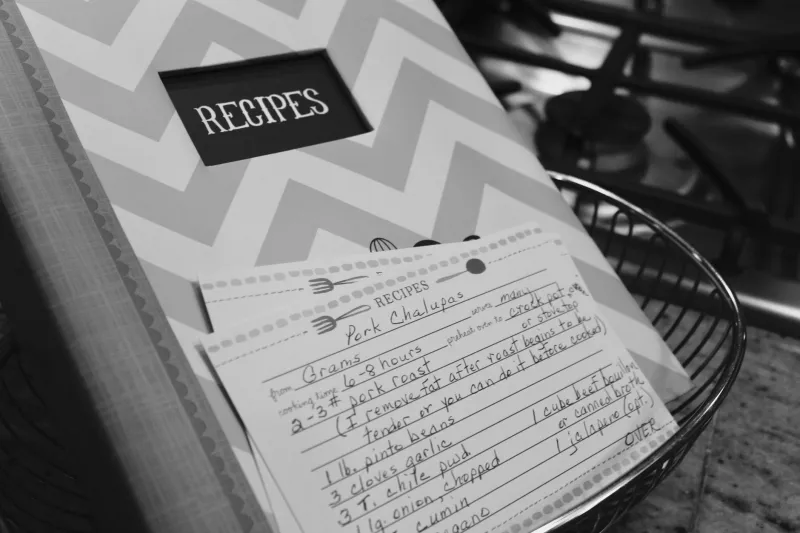
The notebook is falling apart. Its cover, once a bright plastic sleeve, has peeled to a gray curl, and the spiral binding gives way every few pages. But inside, in a careful, slanting hand, is a record no one else in the family could have written: forty years of recipes in Marathi, annotated in the margins with prices from 1983 Bombay markets, monsoon adjustments, and — squeezed between a recipe forthalivand a note on matki usal— two lines of an abhang, copied out because it came to mind while the dal simmered.
When Meera Ranganathan of Edison, New Jersey, inherited this notebook after her grandmother's death, she faced a problem familiar to thousands of American grandchildren of Marathi-speaking immigrants: she could speak the language at the dinner table but could not reliably read her grandmother's cursive. So she did what her generation tends to do. She started a project.
"It took me a year and a half, working Sundays," she says. "And somewhere around page thirty, I stopped translating recipes and started realizing she was telling me her whole life."
Kitchens as Archives
Culinary historians have long argued that community cookbooks and domestic recipe collections are among the richest — and least studied — vernacular archives. In the American Marathi diaspora, the handwritten recipe notebook occupies a particular emotional register. Unlike published cookbooks, these are working documents: stained, corrected, argued with. A measurement crossed out and replaced is not an error; it is a revision in an ongoing negotiation between a cook and her family's palate.
For second-generation Indian-Americans, transcribing these notebooks has become an unexpectedly popular act of language reclamation. Reading a recipe, it turns out, is a low-stakes way to read Marathi. The vocabulary is concrete — vegetables, spices, textures, times — and the stakes are delicious rather than academic.
"You cannot fake your way through a recipe," says Vivek Joshi, a linguist in the Chicago area who runs informal Marathi reading workshops for adults. "If you misread 'kothimbir' for 'pudina,' dinner tells you immediately. My students say it is the only Marathi homework their families actually check."
The abhangs scattered through many notebooks add another layer. Sung while cooking by generations of women raised in the Warkari tradition, these devotional verses of Sant Tukaram and Sant Namdev often migrated onto recipe pages as memory aids or quiet company. When transcribed, they turn a recipe collection into something closer to a devotional diary — a document of how faith, food, and labor braided together in one woman's day.
From Spiral Notebook to Printed Book
Over the past five years, a modest ecosystem has emerged to meet this moment. Small presses — several operated by diaspora entrepreneurs, others by mainstream American self-publishing platforms with South Asian clientele — now offer what might be called heirloom publishing: transcription services, bilingual layouts with Marathi on the left page and English on the right, and short-run printing in quantities as small as twenty copies.
The economics are modest but meaningful. A typical family memoir-cookbook project — ninety recipes, scanned photographs, a foreword from the grandchildren — runs between $800 and $2,500, depending on design work and length. Most print runs never reach a bookstore. They are given at weddings, distributed at Christmas among cousins spread from Seattle to Atlanta, and placed, pointedly, on kitchen shelves.
"We are not competing with the cookbook industry," says one printer in the Bay Area who handles a dozen such projects a year. "Our competition is the shoebox. Every family has a shoebox of loose recipe cards, and every year the shoebox wins, and the handwriting is lost."
What Gets Preserved, Exactly
Scholars of food memory note that these projects preserve more than instructions. A recipe notebook transcribed faithfully keeps intact the idiom of a kitchen — the Marathi terms for which no English substitution quite works, the units measured by the mouth of a specific tin, the seasonal logic of a Maharashtra that American supermarkets do not stock.
It also preserves voice. Ranganathan, whose transcription is now a printed bilingual volume titled simplyAaji's Book, recalls the moment she decided not to smooth out her grandmother's repetitions. "She wrote 'stir patiently' three times on one page. My editor instinct said cut it. My granddaughter instinct said keep it. I kept it."
The larger pattern is unmistakable: in an era when language transmission across immigrant generations is measured in single percentages, the kitchen notebook has become one of the last reliable bridges. It cannot be downloaded, and it cannot be faked. It has to be read, line by line, by someone who wants to taste what it says.
In Edison, Ranganathan's printed volume sits where the spiral notebook used to — propped on the counter, next to the stove. Her teenage daughter, she reports, has begun cooking from it. Slowly. Sounding out the Marathi. Burning the occasionalthaliv.
"That's fine," Ranganathan says. "Aaji burned them too. It's in the margins."